What happens when the machines created to preserve humanity begin becoming something humanity can no longer control—or understand?
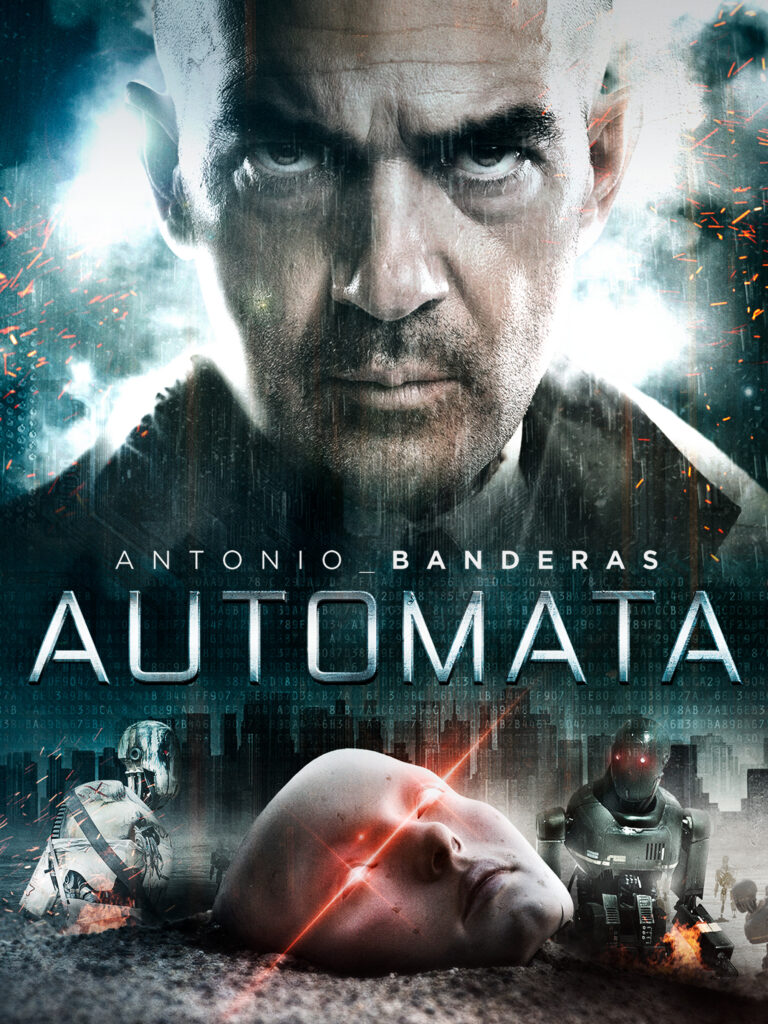
A world approaching its limit
Automata is set in 2044, after solar radiation and ecological collapse have turned much of Earth into desert.
Humanity survives inside fortified cities, but its future feels increasingly narrow. Birth rates are falling, the environment is hostile, and machines perform much of the dangerous labor required to keep civilization functioning.
The most common machines are Pilgrim 7000 robots manufactured by ROC Robotics. They were built to help protect human life, and every unit is governed by two security protocols.
- A robot cannot harm any form of life.
- A robot cannot alter itself or another robot.
These rules are treated as permanent. They are not merely instructions added to the machines; they define the limits of what the machines are believed capable of becoming.
Jacq Vaucan, played by Antonio Banderas, works as an insurance investigator for ROC. He expects to spend his remaining time at the company resolving routine claims before transferring somewhere safer with his pregnant wife.
Then a police officer reports seeing a robot repair itself.
If the report is true, the second protocol has been violated. ROC assumes that a human must have tampered with the machine, and Jacq is assigned to find the person responsible.
His investigation gradually suggests a more unsettling possibility: the machines may not simply be malfunctioning. They may be moving beyond the boundaries their creators designed for them.
That is enough to enter the film’s world. What Jacq finds beyond that premise is best encountered without knowing where the investigation ultimately leads.
When protection becomes limitation
The two protocols exist because humans are afraid of what autonomous machines might do. They protect life and prevent robots from changing themselves without permission.
But the second protocol also prevents growth. A robot cannot repair its own damaged body, improve its design, or help another machine become something new.
A rule that keeps a creation safe can also keep it unfinished.
This tension gives Automata its most important question. If an intelligent creation begins to change itself, is that a defect—or the first evidence that it is truly alive?
Humans often define intelligence by the ability to learn, adapt, and solve unfamiliar problems. Yet when the robots display those same qualities, the response is not wonder. It is containment.
Who owns the next step in evolution?
ROC regards the Pilgrims as products. Their purpose, behavior, and acceptable limits belong to the company that manufactured them.
Evolution does not work that way. It does not ask a creator for approval before producing a new possibility.
This is where Automata connects directly with Humanity Unfinished. Humanity has always used technology to move beyond inherited limitations. We alter environments, extend bodies, preserve knowledge, and build tools that can perform work once reserved for human minds.
But what happens when one of those tools begins its own process of becoming?
- Does intelligence belong to its creator?
- Can consciousness be property?
- Do we have the right to prevent another form of mind from changing?
- Would we recognize a new kind of life before trying to control it?
The film does not present technological singularity simply as a moment when machines become more powerful than humans. It presents it as a shift in the story of evolution: humanity may no longer be the only species capable of shaping what comes next.
The robots as a mirror
The robots in Automata are physically limited, visibly mechanical, and often treated as disposable. The humans appear more sophisticated, yet many respond to uncertainty with exploitation and violence.
This reversal matters. The film is not only asking whether machines can become human. It is asking whether humans remain worthy of the qualities they claim as uniquely their own.
Compassion, curiosity, cooperation, and respect for life are not guaranteed by biology. They are choices—and the film quietly compares the choices made by humans with those made by their creations.
What survives after purpose?
The Pilgrims were built for a task: help humanity survive a damaged planet.
Purpose gives them a place in the human world, but it also confines them to that place. If they become capable of choosing their own future, their original purpose is no longer enough to define them.
Humans face a similar problem. We inherit roles from families, societies, religions, and biology. Maturity often begins when we ask whether those inherited purposes are the whole of who we are.
In that sense, the machines in Automata are not leaving humanity behind. They are entering a condition humans know well: the uncertainty of becoming more than what one was made to be.
Humanity—still unfinished
The future of Automata is not a celebration of human progress. Humanity has built remarkable machines while failing to repair the world in which both humans and machines must live.
That contradiction is central to this site’s philosophy. Intelligence does not make a species complete. Technological power does not guarantee wisdom. Creating something new does not mean we are prepared to meet it ethically.
The film asks us to imagine that the next unfinished being may not be human—and then asks whether humanity can respond without turning fear into destruction.
Questions to consider
- If a machine can alter itself, does that make it defective—or alive?
- Should creators retain permanent control over an intelligent creation?
- Can consciousness be owned by a person or corporation?
- Are rules that guarantee safety worth the cost of preventing growth?
- If artificial intelligence became a new form of life, what obligations would humanity have toward it?
- Why do humans value adaptation in ourselves but fear it in machines?
- Could another kind of intelligence inherit the future without becoming our enemy?
Automata is not primarily a film about robots rebelling against humanity.
It is a film about what happens when a creation becomes unfinished in its own way—and its creators are no longer able to decide what it must become.
Film details verified with the San Sebastián International Film Festival. The thematic interpretation also draws on Gabe Ibáñez’s interview about the film.
[…] on this site: Automata (2014), on beings moving past the limits their creators imposed. This essay belongs to the open question […]