What happens when the body skips fifty-three years, but the heart does not?
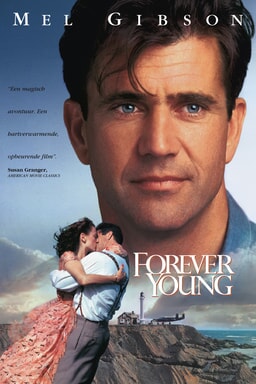
A story about escaping time
Some stories imagine immortality as a triumph.
Forever Young begins somewhere more vulnerable: with a person who no longer wants to remain present for his own grief.
In 1939, Daniel McCormick is a test pilot whose closest friend, Harry Finley, is experimenting with cryonic technology. Harry has developed a chamber intended to place a living subject into suspended animation and revive them later.
Daniel is in love with Helen, but he repeatedly hesitates to say what he most wants to tell her. When Helen is gravely injured and falls into a coma, Daniel finds himself unable to imagine a future without her.
He volunteers for Harry’s experiment.
The plan is for Daniel to remain frozen for one year.
Instead, he is accidentally awakened fifty-three years later by two boys exploring an abandoned military warehouse.
Daniel opens his eyes in 1992.
His body appears to have avoided the passing decades, but the world has not waited for him. Nearly everyone he knew has disappeared, the places he remembers have changed, and his former life survives mainly inside his memory.
With the help of a boy named Nat and Nat’s mother, Claire, Daniel begins searching for answers about the experiment, his friend Harry, and the life he left behind.
That is enough to understand the film’s central question. The rest is best discovered without knowing where Daniel’s search ultimately leads.
Did Daniel travel through time—or lose it?
Daniel has moved from 1939 to 1992, but he has not experienced the years between them.
Biologically, he has escaped more than half a century of aging. Experientially, however, those years are absent from his life.
A longer existence is not necessarily a longer life.
If technology allowed us to skip fifty years without aging, would those missing years count as part of our lives? Or is a life measured by what we experience, remember, and share with others?
Daniel has reached the future, but he did not grow into it. He arrives as a person from another time, carrying emotions that never had the opportunity to change.
Technology preserved a body, not a world
The cryonic chamber protects Daniel from time, but it cannot preserve the relationships and circumstances that gave his life meaning.
His memories remain. The world inside those memories does not.
This is where Forever Young connects deeply with Humanity Unfinished. Technologies that extend life or preserve the body may solve one problem while exposing another.
- Keeping a person alive does not automatically preserve belonging.
- Protecting memory does not recreate the people who shared it.
- Avoiding pain does not necessarily resolve it.
Daniel enters suspended animation partly because he cannot face the possibility of losing Helen. Cryonics becomes not only an experiment in life extension, but also a way of postponing grief.
The technology delays his confrontation with loss. It cannot complete that confrontation for him.
Can love survive missing time?
Daniel’s love for Helen remains emotionally present because, from his perspective, very little time has passed. But more than five decades have passed for everyone else.
This makes the film different from a conventional story about lifelong devotion. Daniel has not spent fifty-three years maintaining his love. He has carried it across an empty interval.
Is a feeling preserved in this way the same as a relationship that has survived change, conflict, aging, and shared experience? Or does love require time lived together?
The film does not treat these questions as abstract philosophy. It places them inside Daniel’s search for the people and promises he left behind.
Forever young—but still unfinished
The title suggests a fantasy humans have pursued for centuries: remaining young while time continues around us.
Yet Daniel’s preserved youth does not make him complete, wise, or free from fear. He awakens with the same hesitation, regret, and unfinished emotional work he carried into the chamber.
Technology has transported him into the future. It has not transformed him into a finished human being.
We can change the condition of a human life without resolving what makes that life difficult. We can preserve a body while leaving its grief untouched. We can arrive in the future while still carrying a conversation we failed to finish in the past.
Questions to consider
- If you could skip fifty years without aging, would those years still belong to your life?
- Is suspended animation a form of life extension, or merely an interruption of life?
- Can love survive when two people no longer share the same passage of time?
- If technology allowed you to postpone grief, would you use it?
- What parts of identity depend on the world and people around us?
- If your body remained young while everything familiar grew old, would youth still feel like a gift?
- Can technology preserve us without preserving the life that made us who we are?
Forever Young is not primarily a film about defeating death.
It is a film about discovering that time can be postponed, but being human cannot.
Film details verified with the AFI Catalog of Feature Films.